Showing posts with label All-Time Teams. Show all posts

Wednesday, September 01, 2021

All-Time Teams #21: Philadelphia Phillies

This is part of a really long ongoing series where I'm naming an all-time team for each of the current 30 MLB franchises.

Franchise History


Philadelphia Phillies (1890- )
Philadelphia Quakers (1883-1889)

An asterisk (*) denotes a Hall of Famer.

Starters
C - Darren Daulton (1983, 1985-1997)
1B - Ryan Howard (2004-2016)
2B - Chase Utley (2003-2015)
SS - Jimmy Rollins (2000-2014)
3B - Mike Schmidt* (1972-1989)
LF - Ed Delahanty* (1888-1889, 1891-1901)
CF - Richie Ashburn* (1948-1959)
RF - Chuck Klein* (1928-1933, 1936-1944)

A bunch of fairly obvious choices here. The advanced stats like Bobby Abreu over Klein in right field, but I decided to give the nod to the Hall of Famer who played most of his career in Philadelphia. 

Rotation
Steve Carlton* (1972-1986)
Robin Roberts* (1948-1961)
Pete Alexander* (1911-1917, 1930)
Cole Hamels (2006-2015)
Jim Bunning* (1964-1968, 1970)

The top three are obvious, but Hamels was a pretty easy choice as well, with his 2008 World Series MVP boosting his case.

Closer
Tug McGraw (1975-1984)

Reserves
C - Carlos Ruiz (2006-2016)
1B/3B/LF - Dick Allen (1963-1969, 1975-1976)
2B - Nap Lajoie* (1896-1900)
SS - Larry Bowa (1970-1981)
3B - Scott Rolen (1996-2002)
OF - Billy Hamilton* (1890-1895)
OF - Bobby Abreu (1998-2006)

I was as surprised as you about Nap Lajoie, but his five seasons in Philadelphia were enough to earn a backup role over the likes of Juan Samuel and Mickey Morandini. Billy Hamilton is another Hall of Famer who didn't play in Philadelphia long, but the team needs a backup center fielder and he's the best choice for that role. 

Sherry Magee is easily the toughest omission here. I think he's a highly underrated player who only falls a little short of being worthy of Hall of Fame discussion, but Dick Allen gets the nod as a guy who can backup at both 1B and LF. 

Bullpen
Curt Schilling (1992-2000)
Chris Short (1959-1972)
Ron Reed (1976-1983)
Curt Simmons (1947-1950, 1952-1960)

Manager
Charlie Manuel (2005-2013)

I figured a team that's been around as long as this team has would have a more celebrated manager, but I was wrong.  

Next Up: Pittsburgh Pirates

Tuesday, January 08, 2019

All-Time Teams #20: Oakland Athletics

I'm trying to revive this ongoing series where I'm naming an all-time team for each of the current 30 MLB franchises, but in the interest of time I'm abandoning the greatest eligible player who is not in the Hall of Fame part. 

Franchise History

Oakland Athletics (1968- )
Kansas City Athletics (1955-1967)
Philadelphia Athletics (1901-1954)

An asterisk (*) denotes a Hall of Famer.

15 Hall of Famers on this squad. Only the Cubs -- who added their 16th and 17th when Ron Santo and Lee Smith, respectively, were elected after I wrote their all-time team post -- have more. 

Starters

C - Mickey Cochrane* (1925-1933)
1B - Jimmie Foxx* (1925-1935)
2B - Eddie Collins* (1906-1914, 1927-1930)
SS - Bert Campaneris (1964-1976)
3B - Sal Bando (1966-1976)
LF - Rickey Henderson* (1979-1984, 1989-1995, 1998)
CF - Al Simmons* (1924-1932, 1940-1941, 1944)
RF - Reggie Jackson* (1967-1975, 1987)

Simmons was the regular center fielder for the first four years of his career, so he makes the position shift that avoids having to relegate one of this franchise's four or five best everyday players to the bench. 

Otherwise, I honestly can't see anyone taking exception with any of these starting picks, unless perhaps you're a Home Run Baker guy.

Rotation

Lefty Grove* (1925-1933)
Eddie Plank* (1901-1914)
Rube Waddell* (1902-1907)
Chief Bender* (1903-1914)
Eddie Rommel (1920-1932)

I suppose some will argue for Catfish Hunter over Rommel, which would give this team a rotation of five Hall of Famers, but a lot of those folks probably don't realize how good Rommel was, especially at the start of his career. Despite three consecutive top four Cy Young finishes -- some of which can be attributed to his win totals while pitching for the iconic 1972-74 dynasty -- nothing Hunter did with the A's can compare to Rommell's 1921-25 stretch while pitching for a mostly bad team.

Closer

Dennis Eckersley* (1987-1995)

Reserves

C - Terry Steinbach (1986-1996)
1B - Mark McGwire (1986-1997)
2B - Max Bishop (1924-1933)
SS - Miguel Tejada (1997-2003)
3B - Frank Baker* (1908-1914)
OF - Bob Johnson (1933-1942)
OF - Dwayne Murphy (1978-1987)

I was going to take Gene Tenace over Steinbach as backup catcher, but Tenace really was only a part-time catcher and Steinbach was an above-average offensive player and solid defender at the position for Oakland for nine years.

Advanced statistically speaking, Eddie Joost might deserve the backup SS spot over Tejada, but Tejada's league MVP and overall presence as a more dominant player wins out.

Henderson, I suppose, could backup Simmons in CF, but since neither of them played the position primarily in their career, Murphy's inclusion is almost essential.

Other tough omissions included Danny Murphy, Eric Chavez and Jose Canseco.

Bullpen

Rollie Fingers (1968-1976)*
Tim Hudson (1999-2004)
Vida Blue (1969-1977)
Catfish Hunter* (1965-1974)

I was seriously considering Barry Zito over Hunter, and he perhaps deserves the final spot on this staff on merit. But, Catfish is in the Hall of Fame, his uniform number is retired, and he's the team's leader in post-Depression era wins. So, despite his status as perhaps this franchise's most overrated player, he has to be represented here.

Manager

Connie Mack* (1901-1950)

It did take Mack five times as many seasons to win four times as many games as Tony LaRussa, but the latter will have to wait until St. Louis to get his due.

Next Up: Philadelphia Phillies

Wednesday, February 24, 2016

All-Time Teams #19: New York Yankees

This is part of an ongoing series where I'm naming an all-time team for each of the current 30 MLB franchises. In an effort to revive this series after a long period of inactivity, I'm placing a little less emphasis on the discussion of the greatest eligible player who is not in the Hall of Fame.

Here's an update of the Hall of Famer per all-time team tally I listed in the Cubs post:

Cubs - 15
Braves - 14
White Sox - 13
Indians - 12
Yankees - 12
Red Sox - 12
Dodgers - 11
Reds - 10
Orioles - 9
Tigers - 9

These numbers include all Hall of Famers, regardless of whether they're inducted as a player, a manager, or in the case of Clark Griffith, an executive. 

A couple teams (Cubs and Indians) have the same Hall of Famer as a player and manager. Of course, I only counted those guys once.

Perhaps it's surprising to some that the Yankees aren't really close to the top of the list. The simple explanation is quite a few Yankees Hall of Famers didn't even make this team, with some even losing out to non-Hall of Famers, although that hardly makes the Yankees unique.

Franchise History
New York Yankees (1913 - )
New York Highlanders (1903 - 1912)
Baltimore Orioles (1901 - 1902)

An asterisk (*) denotes a Hall of Famer.

Starters
C - Yogi Berra* (1946-1963)
1B - Lou Gehrig* (1923-1939)
2B - Robinson Cano (2005-2013)
SS - Derek Jeter (1995-2014)
3B - Alex Rodriguez (2004-2013, 2015- )
LF - Babe Ruth* (1920-1934)
CF - Joe DiMaggio* (1936-1942, 1946-1951)
RF - Mickey Mantle* (1951-1968)

Ruth played a few hundred more games in right, but he's second in franchise history in games played in left field, and was essentially the Yankees' regular left fielder for four seasons. 

Mantle played right in his rookie season before eventually taking over the center field job when DiMaggio retired. This one's more of a stretch, but it's the best way to account for the fact that two of this team's four best players played the same position. 

Cano as the starting second baseman is probably my most controversial selection, and one that certainly would've been different five years ago. His cumulative WAR of 45.1 ranks third at the position, behind Willie Randolph (53.7) and Tony Lazzeri (48.3). But WAR/650 PA tells a different story: Cano - 5.6, Randolph - 5.2, Lazzeri - 4.9. 

While 0.4 WAR per year might not seem like a biggest enough difference to base such a decision on, especially since Joe Gordon's shorter Yankees career rates at 5.8 WAR/650 PA, but I'm skeptical enough of how much of Randolph's value comes from his defense to opt for Cano's offense instead. 

Rotation
Whitey Ford* (1950, 1953-1967)
Ron Guidry (1975-1988)
Red Ruffing* (1930-1942, 1945-1946)
Andy Pettitte (1995-2003, 2007-2010, 2012-2013)
Lefty Gomez* (1930-1942)

You could probably quibble with the order, but otherwise I doubt there's much controversy here. 

Closer
Mariano Rivera (1995-2013)

Reserves
C - Bill Dickey* (1928-1943, 1946)
C - Thurman Munson (1969-1979)
1B - Don Mattingly (1982-1995)
2B/3B/SS - Tony Lazzeri* (1926-1937)
3B - Graig Nettles (1973-1983)
LF/RF - Charlie Keller (1939-1943, 1945-1950)
OF - Bernie Williams (1991-2006)

Leaving Randolph off this team completely is tough -- I briefly considered expanding this team to accommodate him and a few other difficult omissions -- but I could probably put together a pretty great all-time team of players who didn't make my Yankees all-time team. That said, Lazzeri's flexibility to backup at SS as well was the deciding factor in his favor. 

Bullpen
Rich Gossage* (1978-1983, 1989)
Sparky Lyle (1972-1978)
Dave Righetti (1979, 1981-1990)
Mike Mussina (2001-2008)

I'm sure Gossage would choose himself as the team's closer, but everyone except him surely agrees Rivera is a no-brainer. Otherwise, it's a pretty short bullpen, but I've basically been going with 10 or 11 pitchers total depending on the worthiness of 25th man candidates. In this case, I felt Nettles and Munson were more worthy than any of the remaining hurlers. 

Manager
Casey Stengel* (1949-1960)

The Yankees really reinforce how difficult, and perhaps pointless, it is to decide who's the best manager in a franchise's history. Here are the choices:

Miller Huggins (1918-1929): 1067 wins, .597 W-L%, 6 pennants, 3 W-S titles. 

Joe McCarthy (1931-1946): 1460 wins, .627 W-L%, 8 pennants, 7 W-S titles. 

Casey Stengel (1949-1960): 1169 wins, .623 W-L%, 10 pennants, 7 W-S titles.

Joe Torre (1996-2007): 1173 wins, .605 W-L%, 6 pennants, 4 W-S titles.

Of course, it's not just comparing the level of success that makes choosing between these guys difficult, it's the age-old question -- which is especially pertinent to the Yankees -- of whether the manager makes the players great or the players make the manager great.

Obviously, it's probably a combination of those factors, but in the case of the Yankees, it's definitely more the latter than the former. In fact, the Yankees have won six World Series in the 61 seasons they were not managed by these four guys. By comparison, the second most successful franchise in baseball history (Cardinals) have won less than twice that many (11) in more than twice as many years (132), and the Dodgers have won six World Series in 130 years.

That said, Stengel gets the nod because of 10 pennants and seven World Championships in 12 years.

Greatest Eligible non-Hall of Famer

More interesting (to me) than the aforementioned potential second team is a potential all-time team of Yankees eligible for, but not in, the Hall of Fame. 

Thurman Munson is the only career Yankee who's in my personal Hall, but not the real Hall of Fame, so he's my choice here. 

Somewhat surprisingly, Munson's Hall case didn't get the special consideration players with similar circumstances typically get. I suppose he has the double whammy of being a catcher and having an abbreviated career, two factors that, to differing degrees, adversely affect the counting stats voters love. 

Obviously, Roy Campanella had the same potential problem but was unaffected. The guy did win three MVPs. So, perhaps Campanella is the Rickey Henderson to Munson's Tim Raines when it comes to catchers with careers shortened by non-baseball factors. Perhaps that's a stretch, but I'll go with it. 


Friday, June 06, 2014

The All-Yankees-Who-Never-Won-A-World Series Team

I've been working on the next entry in my All-Time Teams series for quite some time now. Actually, "working off and on" would be more accurate than "working on." Of course, since the last entry was the New York Mets, it should be pretty obvious who's up next.

However, at least partly inspired by Replacement Level's recent naming of The All-Never-Won-A-World Series Team, I'm going to allow myself to be sidetracked a little here.

This wasn't an easy exercise as it's pretty difficult finding significant Yankees who never won a World Series with the team. In fact, because of this, I decided not to hem and haw over the reserves and just go with a starting lineup, five-man rotation and relief pitcher.

Not surprisingly, the lineup is dominated by players from the deadball era, the pre-Steinbrenner years and the early-'80s to mid-'90s drought.

C - Mike Stanley
Stanley provided the Yankees with some good offense (134 OPS+) in a mostly full-time capacity from 1992-1995, but was let walk as a free agent, in favor of Joe Girardi, prior to their first World Series of the Jeter era. In August of 1997, the Red Sox traded him back to the Yankees, and he played a part-time role on their only late-'90s team that didn't win the World Series.

1B - Don Mattingly
Easily the most celebrated Yankee who never won a World Series, Mattingly also earned the most WAR for the franchise among players who fit the distinction. Of course, everyone knows Donnie Baseball played in his first postseason in 1995 and then retired fairly young, missing out on the 1996 celebration. He probably has a World Series ring earned during his time as a spring training hitting instructor, but otherwise his coaching and managing career has been similarly frustrating in terms of World Series victories. He became hitting coach in 2004 and left just prior to the 2008 season.

2B - Jimmy Williams
Williams was the franchise's original second baseman and served as the starter at the position from 1901-1907, providing good offense (116 OPS+) and solid overall play (20.7 WAR). He's also the only position player on this roster who played for the team before they were called the Yankees (1901-02: Baltimore Orioles, 1903-07: New York Highlanders).

SS - Roger Peckinpaugh
Peckinpaugh joined the team the year they became known as the Yankees (1913) and was a fixture at shortstop for most of that year and the eight seasons that followed. He played in the franchise's first World Series appearance, in which they lost 5-games-to-3 to the New York Giants in 1921. Following that season, he was part of a blockbuster deal between the Yankees and the Red SoxRip Collins, Jack Quinn, Bill Piercy and Peckinpaugh for Bullet Joe Bush, Sad Sam Jones and Everett Scottbut was subsequently traded to Washington three weeks later. In 1924, he was a member of the Senators' first and only World Series winning team.

3B - Home Run Baker
He had his best seasons with the Philadelphia Athleticswho won it all in 1910, 1911 and 1913 while he was therebefore being sold to the Yankees following a contract dispute over which he sat out the entire 1915 season. Like Peckinpaugh, he played on the World Series losing team of 1921. Unlike Peckinpaugh, he was also a member of the World Series losing team of 1922, his final major league season.

LF - Rickey Henderson
Henderson actually played more games in centerand reasonably wellfor the Yankees than in left, but the latter always seemed like his natural position. The mid-to-late '80s weren't as bad as most people remember, with 1989 being the only year they won less than 85 games. In fact, in Rickey's first and best year in pinstripes (1985), the Yankees won 97 games, but finished two behind the Blue Jays. Henderson played in 60 postseason gamesand won World Series in Oakland and Torontoin his career, but none of them were with the Yankees.

CF - Bobby Murcer
Getting back to our hard-luck stories, Murcer was with the Yankees from 1965-1974 and 1979-1983. You probably know what happened in the intervening four years...three trips to the World Series, two of them victorious. He never quite lived up to expectations (i.e. Mickey Mantle comparisons), but he enjoyed a fine career nonetheless.

RF - Dave Winfield
Little did anyone know when Winfield was dubbed "Mr. May" by George Steinbrenner following a 1-for-22 performance in the 1981 World Series loss to the Dodgers, it would turn out to be his last postseason appearance in pinstripes. He would, however, go on to deliver the game-winning hit in the Blue Jays' 1992 World Series clinching Game 6 victory.

DH - Jason Giambi
Giambi was on the 2003 team that lost the World Series to the Marlins, and I have to admit I didn't remember that he didn't play at all in the 2004 postseason. Judging by his seasons stats, he was injured and/or deemed ineffective when healthy, and I certainly recall watching Tony Clark and John Olerud play, but the Giambi circumstances aren't coming back to me.

RHP - Mike Mussina
Mussina, of course, began his Yankee years on the 2001 team that lost in seven games to the Diamondbacks, then retired following the first 20-win season of his career (2008). He surely could have been an integral part of the 2009 championship team, especially considering they tested the nerves of Yankees fans by getting through the entire postseason with a three-man rotation that included A.J. Burnett.

LHP - Tommy John
TJ's timing wasn't so great either, as he pitched for the Dodgers during their 1977 and 1978 World Series losses to the Yankees, then switched sides to be a member of the 1981 team that lost to the Dodgers. Those three losses would be the extent of John's World Series experience despite a 26-year career.

Mel Stottlemyre and deadball era pitchers Jack Chesbro and Russ Ford, all right-handed pitchers who might bump John if they were southpaws, round out the rotation.

RP - Dave Righetti
Rags never had a breakthrough season as a starter, but the decision to move him to the bullpen at age 25 epitomizes the team's mismanagement during the years between the two successful portions of the Steinbrenner era. I'm not saying letting him remain as a starter would've made the difference, but we never got to find out, did we?

Who did I miss?

Friday, February 21, 2014

All-Time Teams #18: New York Mets

This is part of an ongoing series where I'm naming an all-time team for each of the current 30 MLB franchises, and using this as a vehicle to discuss their greatest eligible player who is not in the Hall of Fame.

The long overdue return of this all-time teams series brings us an installment away from the most difficult one of all.

Franchise History
New York Mets (1962- )

An asterisk (*) denotes a Hall of Famer.

Starters
C - Mike Piazza* (1998-2005)
1B - Keith Hernandez (1983-1989)
2B - Edgardo Alfonzo (1995-2002)
SS - Jose Reyes (2003-2011)
3B - David Wright (2004- )
LF - Cleon Jones (1963, 1965-1975)
CF - Carlos Beltran (2005-2011)
RF - Darryl Strawberry (1983-1990)

Alfonzo played more games at third for the Mets, but his two best seasons were as the team's starting second baseman, making it easy to justify this position switch.

Rotation
Tom Seaver* (1967-1977, 1983)
Dwight Gooden (1984-1994)
Jerry Koosman (1967-1978)
Sid Fernandez (1984-1993)
Jon Matlack (1971-1977)

Closer
John Franco (1990-2001, 2003-2004)

Reserves
C - Gary Carter* (1985-1989)
1B - John Olerud (1997-1999)
2B - Wally Backman (1980-1988)
SS - Bud Harrelson (1965-1977)
3B/SS/OF - Howard Johnson (1985-1993)
OF - Mookie Wilson (1980-1989)
OF - Lenny Dykstra (1985-1989)

The toughest omissions here were Ed Kranepool and John Stearns.

Kranepool is the franchise's all-time leader in games played, at bats and plate appearances, and is in the top five in hits, total bases and RBI, but Olerud had two of the franchise's 25 best seasons by a position player, and racked up more WAR in 1998 than Kranepool did in his entire career. 

Stearns accumulated more value in his 10 years with the Mets than Carter did in his five, the last two of which were the beginning of the end for the Kid. That made this a much tougher decision, but Carter had an MVP-type season in 1985 and was one of the leaders of one of the team's two World Series winners, so that edges him past his fellow four-time all-star.

In the pre-David Wright days, A Mets fan argued with me in favor of Ray Knight over Howard Johnson as the team's all-time third baseman. World Series MVP notwithstanding, that guy was out of his freaking mind. Knight didn't even sniff consideration for a reserve spot on this team.

Bullpen
Jesse Orosco (1979, 1981-1987)
Tug McGraw (1965-1967, 1969-1974)
Al Leiter (1998-2004)
David Cone (1987-1992, 2003)

The most accomplished Mets pitcher to not make it here is probably Ron Darling. I suppose an argument could be made for Billy Wagner, but his time with the Mets was a little too short to justify taking him over Orosco or McGraw, and I had to find a place for rotation runners-up Leiter and Cone.

Manager
Davey Johnson (1984-1990)


Greatest Eligible non-Hall of Famer

There are three players on this team who are in my personal Hall, but not the real thing. 

Mike Piazza played longer with the Mets, but most of his truly great seasons were with the Dodgers. 

Keith Hernandez, despite his status as one of the key members of the '86 Mets, is probably thought of as a Cardinal first. 

David Cone might be considered a Met, or he might be considered a Yankee, for the purpose of the cap depicted on his hypothetical Hall of Fame plaque. 

DwightGoodenSF 2
Image via Wikimedia Commons
So, my choice for the distinction of the greatest eligible player unquestionably identified as a Met, who's not in the Hall of Fame, is Dwight Gooden.

Gooden is a little short of Hall-worthy in my book, but an argument can be made for him based on peak. 

In fact, take a look at this short list of 20th-century pitching WAR leaders through age 23. Four out of six are Hall of Famers, while Gooden (100 ERA+, 18.9 WAR in 1628 IP from age 24 on) joins Frank Tanana as players whose careers could have been so much more. 

Thursday, March 21, 2013

All-Time Teams #17: Minnesota Twins

This is part of an ongoing series where I'm naming an all-time team for each of the current 30 MLB franchises, and using this as a vehicle to discuss their greatest eligible player who is not in the Hall of Fame.

Landon Evanson, who writes for Bugs and Cranks offered invaluable input to the process of selecting this team. In fact, he probably saved me from making a couple head-scratching mistakes due to not placing enough emphasis on the players who led the Twins to their most recent glory.

Franchise History
Minnesota Twins (1961- )
Washington Senators (1901-1960)

An asterisk (*) denotes a Hall of Famer.

Starters
C - Joe Mauer (2004- )
1B - Kent Hrbek (1981-1994)
2B - Rod Carew* (1967-1978)
SS - Joe Cronin* (1928-1934)
3B - Harmon Killebrew* (1954-1974)
LF - Goose Goslin* (1921-1930, 1933, 1938)
CF - Kirby Puckett* (1984-1995)
RF - Tony Oliva (1962-1976)

Moving Killebrew to third base to accommodate Hrbek in the starting lineup seems like a logical move, as the other options at third are nowhere near as good as Hrbek.

There are three Hall of Fame outfielders on this team, but the lesser of the three gets moved to the bench (see below) in favor of Oliva, a guy whose name comes up more than occasionally in discussions about deserving players outside the Hall. That still makes five Cooperstown inductees among this team's starters, and one more (Mauer) who, if his health holds up, could well be on his way.

Rotation
Walter Johnson* (1907-1927)
Bert Blyleven* (1970-1976, 1985-1988)
Johan Santana (2000-2007)
Frank Viola (1982-1989)
Brad Radke (1995-2006)

I'll admit I was initially going to leave Viola out of the rotation, but Landon and a couple other folks on Twitter convinced me otherwise. Looking back, I'm not really sure what I was thinking, but this is why I frequently seek input from others.

Closer
Joe Nathan (2004-2009, 2011)

Reserves
C - Earl Battey (1960-1967)
1B - Joe Judge (1915-1932)
2B - Chuck Knoblauch (1991-1997)
2B/SS - Buddy Myer (1925-1927, 1929-1941)
3B - Gary Gaetti (1981-1990)
OF - Sam Rice* (1915-1933)
OF - Clyde Milan (1907-1922)

I was going to take Eddie Yost over Gaetti, but the latter is another guy Landon lobbied for. In hindsight, I don't think Yost would have been a terrible decision, but Gaetti's place in Twins history earns him just enough extra credit to push him past the walking man.

Bullpen
Firpo Marberry (1923-1932, 1936)
Rick Aguilera (1989-1999)
Camilo Pascual (1954-1966)
Jim Kaat (1959-1973)

Relegating Kaat to the bullpen in favor of Radke might be a controversial choice, but I swear it has less to do with this idiocy than with the fact those same sabermetrics show, rather logically, that Radke's 4.22 ERA in an era when the league average was 4.64 was better than Kaat's 3.34 in a 3.58 league average era.

Manager

Tom Kelly (1986-2001)

No way I was going to opt for anyone besides the skipper who led the team to two of their three World Series wins, although a case could be made for Ron Gardenhire or maybe Bucky Harris, the latter basically because he's the franchise's all-time wins leader.


Greatest Eligible non-Hall of Famer

Kaat and Oliva appeared on the 2012 Hall of Fame Golden Era Committee ballot. Both received significant support, but fell short of the votes needed for induction, with Kaat garnering 10 of 16 votes and Oliva pulling in 8.

Kaat vs. Oliva is an interesting comparison, with Kaat's case based more on longevity, while Oliva enjoyed the better peak. Kaat has the edge in Hall Rating, 85 to 82, but that's probably too close to consider worth hanging my hat on.

I probably tend to favor longevity over peak performance, but in the case of just-below-the borderline candidates, which both of these guys are in my opinion, I sometimes have a different perspective.

While Kaat would likely be a Hall of Famer if he combined a little more peak dominance with his longevity and reached 300 wins, the fact remains he only enjoyed two seasons with an ERA+ of 130 or greater, and three more in the 125-130 range. The rest of his career he was basically an above average pitcher, albeit one who chewed up a lot of innings in the process. His accomplishments are certainly worthy of recognition, but not to the extent that Oliva's are.

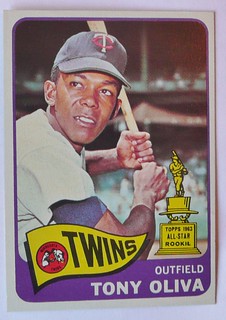
Tony Oliva was a Hall of Fame player for eight years. Unfortunately, eight years of greatness does not make him a Hall of Famer, but it does offer a glimpse of what might have been.

TONY OLIVA MINNESOTA TWINS 1965 #1

From his age 25 to 32 seasons (1964-1971), Oliva was worth 40 WAR, and he was consistent at producing that five WAR per season, with 3.4 being the worst year in that stretch. He also hit .313/.360/.507 during that period, for an OPS+ of 140. In fact, his career OPS+ of 131 would be potentially Hall-worthy if extended over more than 6880 plate appearances.

After 1971, his career was as good as over, though. A knee injury limited his 1972 to just 10 games, and he was unable to return to form after that, putting together 3+ replacement-level seasons as a DH before calling it quits.

Next Up: New York Mets

Friday, February 08, 2013

All-Time Teams #16: Milwaukee Brewers

This is part of an ongoing series where I'm naming an all-time team for each of the current 30 MLB franchises, and using this as a vehicle to discuss their greatest eligible player who is not in the Hall of Fame.

No franchise that started in Seattle has ever won a World Series. The Brewers were only the Seattle Pilots for one year, but their 44 years combined with the Mariners’ 36 adds up to almost as much futility as a certain drought that ended with a “curse” being broken.

Perhaps not surprisingly, there's not a single member of the '69 Pilots on this all-time team.

Franchise History
Milwaukee Brewers (1970- )
Seattle Pilots (1969)

An asterisk (*) denotes a Hall of Famer.

Starters
C - Darrell Porter (1971-1976)
1B - Cecil Cooper (1977-1987)
2B - Jim Gantner (1976-1992)
SS - Robin Yount* (1974-1993)
3B - Paul Molitor* (1978-1992)
LF - Ryan Braun (2007- )
CF - Gorman Thomas (1973-1976, 1978-1983, 1986)
RF - Sixto Lezcano (1974-1980)

When I’m working on these teams, I scour the internet for other all-time teams for comparison purposes. While several of these positions were a consensus, catcher was not one of them. In fact, I saw B.J. Surhoff (no surprise), Ted Simmons (not surprising, but a little misguided) and Dave Nilsson (even though his best years were after he stopped donning the tools of ignorance regularly) as starters on other all-time Brewers teams. They all have it wrong. Porter is the greatest catcher in Milwaukee history.

Don Money was probably a better player than Gantner—for his overall career and his time in Milwaukee—but squeezing Money into the starting lineup would mean moving Molitor to second or playing Money there.* Molitor played almost twice as much at third as he did at second, and Money was only a regular second baseman for one year with the Brewers. Plus, Gantner’s in the franchise’s top five in defensive WAR, runs, hits, total bases and stolen bases, so he’s certainly worthy of being recognized here.

*Or, I suppose Molitor could be the DH, but since for just a little more than half of the team’s history (1973-1997) they were an American League DH-era team, and Molitor was only a regular DH for his final two years in Milwaukee, I chose not to go that route.

Both Ben Oglivie and Geoff Jenkins played primarily left field for the Brew Crew. They accumulated a little more value than Lezcano, so I considered moving one of them to right, but Sixto was a slightly better player (Lezcano: 125 OPS+, 4.1 WAR/162; Jenkins: 116 OPS+, 3.2 WAR/162; Oglivie: 124 OPS+, 3.2 WAR/162) during his shorter tenure and was a true right fielder, so he gets the nod. I promise this has nothing to do with the fact he has perhaps the greatest name in baseball history.

Rotation
Teddy Higuera (1985-1991, 1993-1994)
Ben Sheets (2001-2008)
Chris Bosio (1986-1992)
Mike Caldwell (1977-1984)
Bill Wegman (1985-1995)

Closer
Dan Plesac (1986-1992)

Reserves
C - B.J. Surhoff (1987-1995)
1B - George Scott (1972-1976)
IF - Don Money (1973-1983)
3B - Jeff Cirillo (1994-1999, 2005-2006)
OF - Ben Oglivie (1978-1986)
OF - Geoff Jenkins (1998-2007)

Typically, I insist on each team having a realistic bench. This includes carrying at least one player capable of backing up at each position, most importantly catcher, shortstop and center field. Neither Oglivie nor Jenkins is a legitimate option in center, but Yount is, so we've got that covered. However, Money's days as a shortstop were mostly numbered by the time he arrived in Milwaukee. In fact, Molitor played more games there as a Brewer. So, this team is a little weak on the bench at that position. But, what was I supposed to do, take Jose Valentin?

Bullpen
Rollie Fingers* (1981-1982, 1984-1985)
Ken Sanders (1970-1972)
Mike Fetters (1992-1997)
Yovani Gallardo (2007- )
Jim Slaton (1971-1977, 1979-1983)

Fingers is a Hall of Famer, but his time in Milwaukee doesn't compare to Plesac's run as closer there, so he'll have to share setup duties with Sanders and Fetters, while Gallardo and Slaton fill the long reliever/spot starter roles. Slaton is the franchise's all-time wins leader, but his 97 ERA+ says he was basically an average pitcher. An average pitcher over 2000+ innings of work, that is, which still earns him a spot on this team.

Manager
Harvey Kuenn (1975, 1982-1983)

Kuenn is certainly the most famous manager in the Brewers' short history, having led a team that was nicknamed Harvey's Wallbangers to the franchise's one and only World Series appearance in 1982. But, considering he only managed one full season, the 1983 campaign in which his team finished a respectable 87-75 and he was subsequently fired, his selection isn't a no-brainer.

Greatest Eligible non-Hall of Famer

I've said this before, but this selection can be a little tricky. Here I'm looking for the best Hall-eligible player who would wear a Brewers cap on his plaque if he happened to be elected. There are three Hall of Famers on this team, and Braun and Gallardo are still active, so that leaves 20 remaining candidates.

Among those 20, only Cecil Cooper, Don Money, Jeff Cirillo, George Scott, B.J. Surhoff and Darrell Porter were worth over 30 career WAR. I'll add Teddy Higuera (28.9) to the mix, because he falls just short and is the only pitcher really worthy of this discussion. Between them, this group received a grand total of four Hall of Fame votes, so I probably don't need to say that it's pretty slim pickings.

Surhoff, who quite unbelievably received two of the four aforementioned votes, played one more year in Milwaukee than in Baltimore, but enjoyed most of his better seasons with the Orioles, including his only All-Star appearance and two trips to the postseason, so I'm ruling him out.

Porter played almost an identical number of games with Milwaukee, Kansas City and St. Louis, but his best years were clearly the Royals years, including two top ten MVP finishes and three All-Star appearances, so he's out.

That leaves Cooper, Money, Cirillo, Scott—who played longer in Boston, but clearly had his best years in Milwaukee—and Higuera, who technically isn't Hall-eligible because he only played nine years, but that's kind of a silly rule. Here's how they look based on Hall Rating:

Cooper - 63
Higuera - 63
Cirillo - 63
Money - 61
Scott - 57

Just what I thought. Well, I'll admit I really didn't expect Cirillo to rank that highly, but I'm not surprised there's really not much separating these guys in terms of their overall careers. In such cases, I like to fall back on who produced the most for the team in question. That essentially means it's down to Higuera and Cooper, who are 4th and 5th in team history in WAR, after Yount, Molitor and Braun.

Higuera's an interesting case—although, as I previously said, he's technically not eligible for the Hall of Fame—but I'm sticking with my original decision that Cecil Cooper is the Brewers' greatest eligible non-Hall of Famer. Cooper is basically third (behind Yount and Molitor) in the team's history in just about every offensive category: runs, hits, total bases, doubles, runs created, extra base hits, times on base. Alright, that's a bit of an exaggeration, but he's also second all-time in RBI.

Cooper enjoyed a nice five-year peak from 1979-1983, during which he batted .320/.359/.517 (143 OPS+) with 123 HR, 535 RBI and 459 runs scored, winning three Silver Sluggers, and finishing 5th in AL MVP voting three times and 8th another time. He also won two Gold Gloves and was named to four All-Star teams during a period in which he was worth 23.3 WAR.

These years comprise his age 29 to 33 seasons, so he was a bit of a late bloomer. He also didn't produce much beyond his prime, so there are no Hall of Fame discussions regarding Cecil Cooper. Still, for a short period of time, he was capable of producing at a high level and he's certainly a player worth remembering.

Next Up: Minnesota Twins

Thursday, December 06, 2012

All-Time Teams #15: Miami Marlins

This is part of an ongoing series where I'm naming an all-time team for each of the current 30 MLB franchises, and using this as a vehicle to discuss their greatest eligible player who is not in the Hall of Fame.

I apologize for the two-month hiatus between entries in this series, but...you know, life happens. Plus, I've had a few other things to write about in my occasional free moments in the meantime.

But, I'm pleased to finally get around to completing the most-anticipated of the all-time teams. That is, the most successful franchise in baseball history other than the Yankees...in terms of frequency of World Series victories.

That's right, the Marlins' two World Series in 20 years (10%) is second to the Bombers' 27 in 112 seasons (24.1%), with the Cardinals ranking third (11-of-131, 8.4%).

Franchise History
Miami Marlins (2012-)
Florida Marlins (1993-2011)

Starters
C - Charles Johnson (1994-1998, 2001-2002)
1B - Jeff Conine (1993-1997, 2003-2005)
2B - Luis Castillo (1996-2005)
SS - Hanley Ramirez (2006-2012)
3B - Miguel Cabrera (2003-2007)
LF - Cliff Floyd (1997-2002)
CF - Juan Pierre (2003-2005)
RF - Gary Sheffield (1993-1998)

Choosing Pierre over Cody Ross was a tougher decision than you'd think. Ross rates higher in terms of WAR and WAA (Wins Above Average), but a lot of that value comes from better defense (a lot of it in just one year), which I'm not certain might be over-rated. Besides, for a team that's won two World Series in 20 years, being a key member of one of those championships has to enter into it. 

The only other difficult decision was Sheffield or Giancarlo Stanton in right field. Check back in a year and Stanton will probably get promoted to starter, assuming he's still wearing a Marlins uniform at that point.

Rotation
Josh Johnson (2005-2012)
Kevin Brown (1996-1997)
Dontrelle Willis (2003-2007)
Anibal Sanchez (2006-2012)
Josh Beckett (2001-2005)

Brown had two pretty phenomenal years in south Florida, but Johnson's years of service earn him the nod as staff ace. Otherwise, the choice between Beckett and A.J. Burnett for the final rotation spot was pretty easy once the 2003 World Series was factored in.

Closer
Robb Nen (1993-1997)

Reserves
C - Mike Redmond (1998-2004)
1B - Derrek Lee (1998-2003)
2B - Dan Uggla (2006-2010)
SS - Edgar Renteria (1996-1998)
3B - Mike Lowell (1999-2005)
OF - Giancarlo Stanton (2010- )
OF - Cody Ross (2006-2010)

I could have gone with Ivan Rodriguez over Redmond on the basis of his one very good season in Florida, but Redmond is second to Johnson in games caught and accumulated more value than Rodriguez. Besides, I have tough time considering a guy who played only one year for the Marlins—even a team with as short a history as this—as an all-time team member.

Lee versus Kevin Millar was pretty close in terms of overall value, but Lee shows up in the franchise's top ten in so many counting stats (Runs, Hits, Total Bases, HR, RBI), giving him the edge. Of course, that's because he played longer with the Marlins and basically means he was less good over a longer period, but so be it.

Alex Gonzalez gets left off in favor of Renteria, and not just because of the most important hit in team history. Gonzalez's eight years in Florida land him in the top ten in a few important categories (dWAR, Runs, Hits, Total Bases, RBI), but WAR flat out despises him, mainly because it doesn't rate him as well on defense as his reputation.

Bullpen
A.J. Burnett (1999-2005)
Carl Pavano (2002-2004)
Brad Penny (2000-2004)
Ricky Nolasco (2006- )

Nolasco and his 93 ERA+ squeaks into the final pitching slot only because he's the team's all-time wins leader.

Manager
Jack McKeon (2003-2005, 2011)

Of course I had to choose one of the two managers who guided the Marlins to World Series victories. McKeon gets the nod over Jim Leyland because he took over a 16-22 team and directed a pretty impressive turnaround that ended with Beckett shutting down the Yankees in the season's finale. He also guided the team to two more decent seasons following their post-Series overhaul, so he gets a few bonus points for that.


Greatest Eligible non-Hall of Famer

Based on playing just two seasons for the Marlins, Charles Johnson doesn't qualify for this honor. Obviously, it's pretty slim pickings otherwise, as Johnson and Conine—newly eligible this year, but sure to drop off the ballot after one round of voting—are the only options.

Although I'm sure Conine is considered a more important player to the team's history, Charles Johnson is the easy choice here. While far from worthy of serious Hall of Fame consideration, Johnson was one of the best players in the game at his position for a few years, winning four legitimate Gold Gloves and adding decent—sometimes above average—offense.

Next Up: Milwaukee Brewers

Thursday, September 13, 2012

All-Time Teams #13: Los Angeles Angels of Anaheim

This is part of an ongoing series where I'm naming an all-time team for each of the current 30 MLB franchises. 


Franchise History

Los Angeles Angels of Anaheim (2005- )
Anaheim Angels (1997-2004)
California Angels (1965-1996)
Los Angeles Angels (1961-1964)

An asterisk (*) denotes a Hall of Famer.

Statistics referenced for each player are plate appearances (for hitters), innings pitched (for pitchers), Baseball-Reference WAR and Wins Above Average (WAA), OPS+ (for hitters) and ERA+ (for pitchers).


Starters

C - Brian Downing (1978-1990, 6912 PA, 35.3 WAR, 15.8 WAA, 126 OPS+)
He only caught for two-plus seasons with the Angels, but I had to find a place in the starting lineup for the player who ranks third in team history in position player WAR and among the top five in numerous offensive categories (including OBP, runs, hits, total bases, home runs, RBI, and OPS+).

1B - Darin Erstad (1996-2006, 5789 PA, 30.4 WAR, 12.9 WAA, 96 OPS+)
Erstad just as easily could have been the center fielder, but I opted for him here, because I liked this team's other center field option better than its remaining first base options.

2B - Bobby Grich (1977-1986, 4876 PA, 32.9 WAR, 19.1 WAA, 124 OPS+)
The greatest player who should be wearing an Angels cap on a Hall of Fame plaque, in my opinion, and certainly that of a lot of other folks. Grich ranks 7th among eligible non-Hall of Famers in wWAR. [He's actually 6th--not counting Pete Rose and Joe Jackson--on the list this link directs to, but I believe he's now 7th based on the as-yet-unpublished newest calculation of wWAR.]

SS - Jim Fregosi (1961-1971, 5945 PA, 43.3 WAR, 26.5 WAA, 116 OPS+)
Maybe somewhat surprisingly, Fregosi is the Angels' all-time leader in position player WAR.

3B - Troy Glaus (1998-2004, 3479 PA, 20.8 WAR, 10.3 WAA, 120 OPS+)
The 2002 World Series MVP earns the nod at the hot corner.

LF - Garret Anderson (1994-2008, 8480 PA, 23.7 WAR, -1.7 WAA, 105 OPS+)
The advanced metrics don't think as highly of the Angels' all-time leader in numerous categories (including runs, hits, total bases and RBI) as he was regarded when he was hitting 3rd, 4th and 5th in the team's lineup all those years, but he's still good enough to earn a starting job.

CF - Jim Edmonds (1993-1999, 2951 PA, 19.1 WAR, 10.3 WAA, 119 OPS+)
Edmonds was better in St. Louis than Anaheim, but he still played well enough for the Angels to make the starting nine.

RF - Tim Salmon (1992-2004, 2006; 7039 PA, 37.1 WAR, 16.1 WAA, 128 OPS+)
The team's career home runs leader is also the longest tenured career Angel on this team.

DH - Vladimir Guerrero (2004-2009, 3606 PA, 20.9 WAR, 10.0 WAA, 141 OPS+)
Since almost 80% of the team's existence has been in the DH era, this lineup needs a DH, and the Angels' all-time leader in OPS+ is the perfect candidate for the job.


Rotation

Chuck Finley (1986-1999, 2675 IP, 48.7 WAR, 27.1 WAA, 118 ERA+)
The underrated Finley is the team's career leader in pitching WAR and wins, and earns the spot as the ace of the rotation.

Nolan Ryan* (1972-1979, 2181 IP, 37.6 WAR, 20.3 WAA, 115 ERA+)
No offense to Texas, but Ryan should be wearing an Angels cap on his Hall of Fame plaque.

Frank Tanana (1973-1980, 1615 IP, 32.5 WAR, 19.7 WAA, 118 ERA+)
I had Frank Tanana's autograph as a kid, but that didn't influence my decision. He seriously deserves to be here.

Jered Weaver (2006- , 1292 IP, 27.2 WAR, 16.5 WAA, 128 ERA+)
The only active Angel among the starters on this team is under contract until 2016, so if he keeps it up, we could eventually see him at or near the top of this rotation.

Mark Langston (1990-1997, 1445 IP, 24.4 WAR, 12.6 WAA, 109 ERA+)
Langston still carries around the dubious distinction of being the key piece the Expos got in return when they traded a young Randy Johnson, but he had a nice career otherwise.


Closer

Francisco Rodriguez
(2002-2008, 452 IP, 15.5 WAR, 8.9 WAA, 189 ERA+)
I'll wonder aloud if Percival would be the popular pick among Angels fans, but I can't help but favor K-Rod's 189 to 157 ERA+ advantage as the deciding factor, considering the two are virtually equal based on the value metrics.


Reserves

C - Bob Boone (1982-1988, 3391 PA, 10.8 WAR, 1.2 WAA, 71 OPS+)
1B - Rod Carew* (1979-1985, 3570 PA, 16.2 WAR, 6.2 WAA, 119 OPS+)
IF/OF - Chone Figgins (2002-2009, 4075 PA, 20.8 WAR, 8.5 WAA, 99 OPS+)
3B - Doug DeCinces (1982-1987, 3268 PA, 17.5 WAR, 8.5 WAA, 117 OPS+)
OF - Torii Hunter (2008- , 2913 PA, 18.7 WAR, 9.8 WAA, 121 OPS+)

I'm sure there are some who would have Boone and Carew as starters. But, I prefer Downing's offense to Boone's defense, and Carew provides a good example of my all-time team philosophy of not letting a player's entire career overshadow his performance with the team in question. Figgins' inclusion might seem a bit surprising at first, but his Angels years were quite good and his versatility was invaluable.


Bullpen

John Lackey
(2002-2009, 1501 IP, 22.9 WAR, 10.5 WAA, 116 ERA+)
Troy Percival (1995-2004, 587 IP, 16.2 WAR, 8.2 WAA, 157 ERA+)
Dean Chance (1961-1966, 1237 IP, 19.1 WAR, 10.3 WAA, 122 ERA+)
Jarrod Washburn (1998-2005, 1153 IP, 18.7 WAR, 9.2 WAA, 114 ERA+)
Scot Shields (2001-2010, 697 IP, 11.4 WAR, 5.5 WAA, 139 ERA+)


Manager

Mike Scioscia
(2000- , 1143-943 W-L, 1 WS)
Scioscia's teams haven't had much postseason success, other than winning the 2002 World Series, but he could be building himself a nice Hall of Fame case.


Next Up: Los Angeles Dodgers

Friday, August 31, 2012

All-Time Teams #12: Kansas City Royals

This is part of an ongoing series where I'm naming an all-time team for each of the current 30 MLB franchises, and using this as a vehicle to discuss their greatest eligible player who is not in the Hall of Fame.

I honestly think this was the easiest team to select so far. Seriously, other than maybe Mike Sweeney vs. John Mayberry at first base, are there any debatable decisions in the starting lineup? Well, Carlos Beltran technically only played three games in right field for the Royals. But, I think he needs to be in the starting lineup, we know he can handle the position, and it makes sense to move him rather than Otis, even though dWAR says otherwise.

The rotation is a little grayer, depending on whether you prefer wins or WAR. I'm obviously partial to the latter, but I do think being a team's all-time wins leader counts for something. In this case, it means Paul Splittorff gets a spot on the team, albeit not in the starting rotation.

We also see our first team with a DH here. The Royals have been in existence, and in the American League, since 1969. The DH has been around for all but four of their 44 years (this season included), so adding a DH to this team seems to make sense.

The reserves weren't as much of a slam-dunk as the starters, but they weren't as difficult as some previous teams. It's kind of a short bench because of the DH, but I've got all the positions covered with capable backups.


Franchise History
Kansas City Royals (1969- )

An asterisk (*) denotes a Hall of Famer.

Starters
C - Darrell Porter (1977-1980)
1B - John Mayberry (1972-1977)
2B - Frank White (1973-1990)
SS - Freddie Patek (1971-1979)
3B - George Brett* (1973-1993)
LF - Willie Wilson (1976-1990)
CF - Amos Otis (1970-1983)
RF - Carlos Beltran (1998-2004)
DH - Hal McRae (1973-1987)

Rotation
Kevin Appier (1989-1999, 2003-2004)
Bret Saberhagen (1984-1991)
Mark Gubicza (1984-1996)
Zack Greinke (2004-2010)
Dennis Leonard (1974-1983, 1985-1986)

Closer
Dan Quisenberry (1979-1988)

Reserves
1B/C - Mike Sweeney (1995-2007)
3B/1B - Kevin Seitzer (1986-1991)
IF - Jose Offerman (1996-1998)
LF/3B - Alex Gordon (2007- )
OF - Johnny Damon (1995-2000)

Bullpen
Jeff Montgomery (1988-1999)
Charlie Liebrandt (1984-1989)
Larry Gura (1976-1985)
Paul Splittorff (1970-1984)
Joakim Soria (2007- )

Manager
Dick Howser (1981-1986)

I could just as easily have turned the reigns of this team over to Whitey Herzog, but this time I decided skippering a team to their one and only World Series victory trumps everything else.


Greatest Eligible non-Hall of Famer

As relatively easy as some of the position choices were here, deciding the Royals' greatest eligible non-Hall of Famer was pretty hard for a couple of reasons.

First, I really like Dan Quisenberry. I think he's probably as worthy of the Hall of Fame as Bruce Sutter and Rollie Fingers, maybe even more deserving than the latter. But, the Hall-worthiness of relievers is a difficult subject, one I'm still trying to wrap my head around. Don't get me wrong. I'm not one of those folks who thinks none of them belong, but I'm leaning towards believing Hoyt Wilhelm, Goose Gossage and, in the future, Mariano Rivera are the only guys who should be in.

So, I really think Kevin Appier and Bret Saberhagen are better candidates for this distinction. Which brings me to the second reason this is such a dilemma. Appier would be the choice based solely on their respective Royals careers, but that's mainly because he pitched longer in Kansas City than Saberhagen did.

Bret Saberhagen
Bret Saberhagen
Saberhagen produced almost as much value for the Royals as Appier did, plus he had some success outside of Kansas City. The two Cy Young awards are a factor as well, so Bret Saberhagen is my choice as this team's best eligible non-member of baseball's most exclusive club.**


**I was going to say "baseball's most exclusive club that has also admitted the likes of Tommy McCarthy, Lloyd Waner, Rube Marquard, etc.," but I decided not to. Well, sort of.

As we try to break the shackles of our prior conceptions about Hall-worthiness, we realize Saberhagen came much closer to a Hall of Fame career than we previously thought.

Forget that he didn't win 200 games. Sandy Koufax didn't win 200 games. Neither did Dizzy Dean. And those are just the two most famous Hall of Fame pitchers with less than 200 wins. You can also add Jack Chesbro, Dazzy Vance, Ed Walsh, Rube Waddell, Lefty Gomez and Addie Joss to that list, among players inducted because of their starting pitching accomplishments. But, I want to talk about Koufax and Dean.

Now, before you start proclaiming that Saberhagen was no Koufax or Dean, let me just say that statement isn't as obvious as you'd assume.

Dean pitched just under 2000 innings in his abbreviated career, so I think it's fair to use that basis as the starting point for a comparison.

Through roughly the first 2000 IP of their careers:

Koufax: 138-78, 125 ERA+, 40.3 WAR, 2 CYA

Saberhagen: 134-94, 128 ERA+, 48 WAR, 2 CYA

Dean: 150-83, 131 ERA+, 41.3 WAR, 2 CYA***

***The Cy Young award didn't actually exist when Dean pitched, but he won one MVP and finished second twice. One of those second place finishes was to Carl Hubbell, so I'm giving the assumed Cy to Hubbell that year, but awarding it to Dean for his other second place finish, to Gabby Hartnett.

Do you see that big a difference between these guys, except for the fact Koufax and Dean are Hall of Famers, and Saberhagen dropped off the ballot after receiving just 1.3% of the vote in his first year of eligibility?

Koufax produced one more monster (10 WAR) season (probably the best of his career) then was forced to retire, and Saberhagen stuck around for 4+ additional injury-plagued seasons in which he produced when healthy (488 IP, 33-23, 118 ERA+, 8 WAR). Of course, Dean's career was over at that point.

Again, not really much separation between these careers. I made this particular comparison because Koufax and Dean are possibly the most notable Hall of Fame pitchers who got there on the strength of brilliant peaks rather than longevity, and because Saberhagen had kind of a similar career. I won't try to deny Koufax was clearly the best of the three, but not by as much as you'd think. And, I honestly wouldn't really say Dean was better at all.

Here's an interesting comparison of how remarkably similar Saberhagen's and Dean's primes were. Both pitchers peaked early and had tremendous five-year stretches before injuries got the best of them. Neither threw more than 200 innings in a year after their age-26 season.

Honestly, the main differences were that Dean was on a better team and more of a workhorse—although the latter can really be attributed to the difference in the eras they played in—and Saberhagen was able to come back from injury to enjoy some modest success in his 30s, a factor that could also be attributed to his era.

Saberhagen (1985-1989): 82-50, 130 ERA+, 1171 IP, 29.1 WAR, 2 CYA

Dean (1932-1936): 120-65, 130 ERA+, 1531 IP, 32.6 WAR, 2 CYA***

Should Saberhagen be a Hall of Famer? I'll admit I didn't use to think so, but my opinion is definitely evolving. I'll also admit my judgment used to be clouded by the not-necessarily-accurate subjective evaluations of players from the good 'ole days.

The philosophy that "I know a Hall of Famer when I see one" is still all too prevalent today. I'll concede, ever so slightly, to the folks who subscribe to this theory that maybe there should be a small measure of this in our present-day evaluations of players. But, when we think we can make comparisons to players we've never seen, we end up relying on what can best be described as a generational version of the telephone game that might go something like this:

Grandpa: "Dizzy Dean was the greatest pitcher I ever saw...for those three years in the mid-'30s there was no one better."

Son: "My dad said Dizzy Dean was the greatest pitcher he ever saw...and he saw Carl Hubbell and Lefty Grove pitch. He even saw Walter Johnson at the tail end of his career."

Grandson: "My grandfather saw Carl Hubbell, Lefty Grove and Walter Johnson pitch, and he says Dizzy Dean was better than all of them."

I'm sure I'll be digging up this argument again when it comes time to consider Johan Santana's Hall of Fame credentials.

Next Up: Los Angeles Angels of Anaheim